
Ashlaa (1) What is Ashlaa?
This subject is both sensitive and complex. In acknowledging this I present this statement in three parts. 1. What is Ashlaa? 2. My Creative Process 3. Why Tatreez Strawberries? I first came across the word ashlaa at a demo in Preston in April 2025. There I heard a moving speech by Mohammed, a young Palestinian born in the Jabalia Refugee camp but now working as a medic in Preston. This led me to explore the concepts around ashlaa which I present within this exhibition. What then is ashlaa? The Arabic word “ashlaa” (أشلاء-) refers to scattered body parts and dismembered flesh and bones resulting from extreme violence. In the context of the genocide in Gaza and the broader Palestinian experience this encompasses Israeli military action and describes the horrific reality of conflict. The term ashlaa is relatively new in public discourse, gaining traction in 2024 through academic and activist writers such as Nadera Shalhoub-Kevorkian. She cites Bisan Atef Owda who states: “How can we understand Palestine? We have to start with its people, even as ashlaa.” Ashlaa concerns everyone in Gaza now, and also offers us a vital concept for grasping the situation, when speaking about ashlaa is a refusal to be passive in a horrifying situation. The gathering of ashlaa allows families the dignity of burying their loved ones, to honour their memory and enable closure. However at another level it’s seen as resistance – a refusal to be dehumanised. In the face of atrocities – aimed at fragmenting their bodies, communities and social fabric – Palestinians affect their agency and express their humanity through the carefully gathering and burying of ashlaa. Shalhoub-Kevorkian states:“Joining Gazans in collecting the ashlaa of their loved ones by thinking through the meanings of ashlaa enacts a hope for creating living possibilities despite the genocidal impossibility of life in Gaza.” It’s my hope that if you are unaware of ashlaa this exhibition will encourage you to think through its meanings.
Ashlaa (2) My Creative Process
Sarah Ihmoud asks:
“What can the written word do to hold the pain of a mother tearing into the sand searching for her son’s dead body, or to comfort the child who has lost her entire family?”
I ask a similar question. How too can an artist illustrate the pain and express the complexity within this word ashlaa while affirming its agency?
I have no illusions about comprehensively covering this subject but I hope that as you interact with these ashlaa installations your knowledge and respect will be deepened, just as mine was after discovering this word, when it comes to the resilience of the Palestinian People.
Nadera Shalhoub-Kevorkian’s essay describes harrowing scenes, such as a father holding plastic bags containing his children’s ashlaa or a mother reclaiming her daughter’s “fatafeet” (cut-up pieces) after an attack.
In this installation I have chosen a non-graphic process to maintain dignity and to avoid the risk of sensationalising or exploiting trauma. By not using graphic representations of such atrocities I hope to avoid exploiting Palestinian suffering for shock value – a general concern in art addressing genocide.
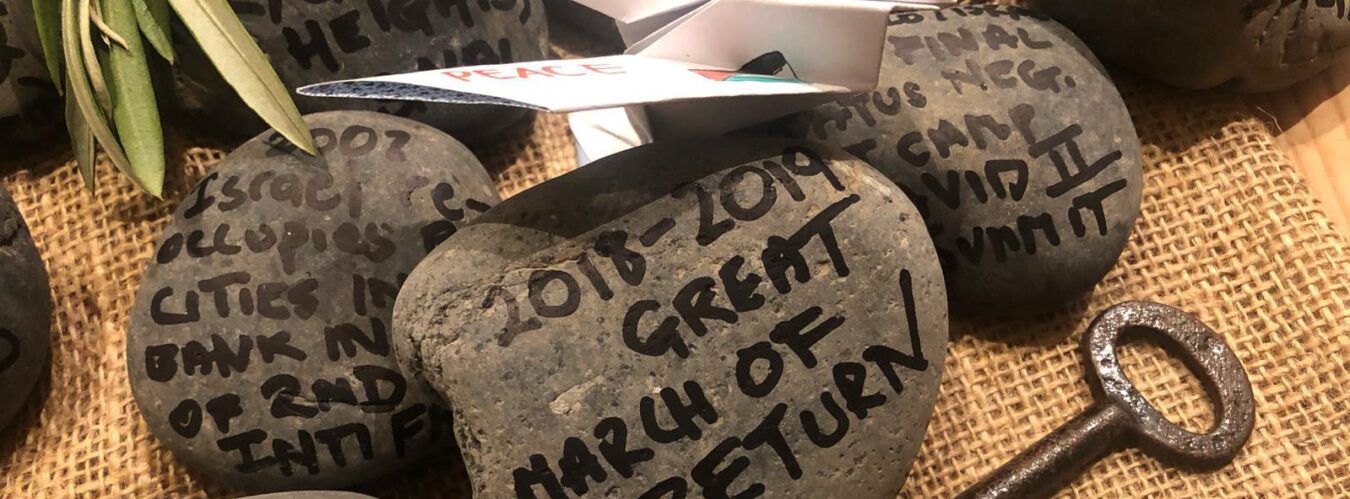
Throughout the exhibition I have used pebbles/stones. This alludes to the fact that Israel is “A Stones Throw Away” from Gaza” – (see also Installation with this title.) This geographic proximity inevitably heightens tensions.
The Animation:
Here I use “loving hands” to symbolically gather and reunite ashlaa. Four central pebbles with the words ‘Reunite’, ‘Body’, ‘Mind’ and ‘Soul’ written on them (in Arabic and English) convey the interconnected nature of physical acts, mental identity, and spiritual hope in the context of genocide. Tatreez strawberries appear and then gather together to lovingly encircle the gathered stones – the ashlaa.
The Installations:
Installation (1) is very simple. The four central pebbles are encircled by others which have text depicting ashlaa/body parts (in Arabic). In turn these are encircled by tatreez strawberries.
Installation (2)
The New Arab published a collection of photos on June 5 2025 showing how people identified the remains of their loved ones. The collection revealed how a young woman identified her mother’s ashlaa from the ring on her hand. A child’s ashlaa were identified from pyjamas. A brother’s ashlaa were identified by the car keys in his hand. In the installation I have added these ordinary artefacts to symbolise and commemorate their violent deaths and those of countless others.
This collage rests on a weathered canvas of decayed strawberries. Again all are gathered, encircled by tatreez strawberries.
The canvas displays a quote by Bisan Atef Owda, cited in Nadera Shalhoub-Kevorkian’s essay. The text that follows is inspired by Shalhoub-Kevorkian’s reflections on ashlaa as a shared reality in Gaza.
Ashlaa (3) Why Tatreez Strawberries?
As this exhibition is called “Strawberry Fields to Killing Fields” it would seem appropriate to use strawberries as the motif for tatreez presented throughout the exhibition. Why the same motif should be used in the installation exploring ashlaa is less obvious. The strawberry motif within this ashlaa installation is most definitely not intended to make light of the horrific reality of dismembered bodies. Rather, the strawberries present a message of life and connection to the land by way of contrasting the vibrancy of Palestinian culture with the devastation of colonial violence. The same purpose is served by the their presence in other installations within this exhibition. Sarah Ihmoud frames ashlaa as a critical feminist methodology reflecting a form of heroism that is not about individual triumph but about collective survival and memory-making. Tatreez can be viewed through a similar lens. Tatreez is traditional Palestinian embroidery and has been a powerful tool for women in Gaza to foster community amidst ongoing conflict and occupation, to express resistance and to preserve cultural identity. Including tatreez in an installation about ashlaa honours the dual role of women as cultural preservers and mourners, weaving narratives of survival amidst loss. The tatreez strawberries presented throughout this exhibition were created by a number of women in Lancaster and the surrounding districts – even one in Sheffield. A dedicated group called “The Tatreez Strawberry Group” was formed in Lancaster.
Christine Dawson
2025